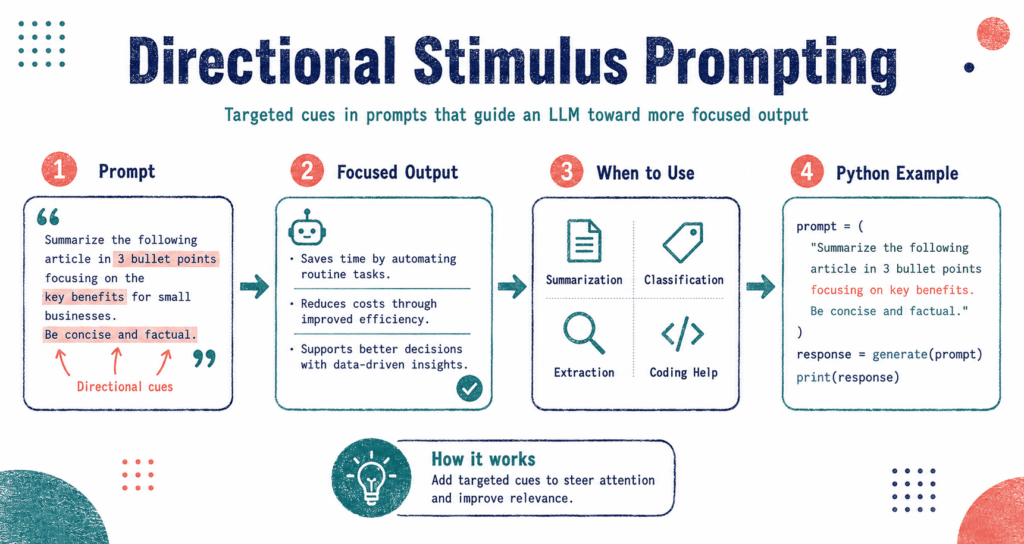
When you prompt an LLM without direction, the model fills the gaps-sometimes usefully, often not. Directional stimulus prompting gives you a simple way to close that gap. By embedding specific cues directly into your prompt before generation begins, you steer the model toward the output focus, structure, and detail level you actually need.
What Is Directional Stimulus Prompting?
Directional stimulus prompting (DSP) is a technique where specific hints-keywords, structural signals, or content anchors-are embedded into a prompt before the LLM generates a response. Those cues narrow the model’s output space so it stays on the topic, format, or attribute set you care about.
The approach was formalised in a 2023 research paper on arXiv, where a lightweight policy model generated keyword stimuli that were prepended to the main prompt. The larger LLM then used those signals as anchors. In practice, a policy model is optional. Manually written stimulus cues work well for most tasks, and that is where most practitioners start.
DSP is not the same as chain-of-thought prompting, which guides the model’s reasoning process step by step. A directional stimulus targets what the response should contain-not how the model should think through the problem. That distinction matters when you are choosing which technique fits your task.
How It Works
A Quick Python Example
The example below applies both approaches to the same task. The stimulus version adds keyword cues before the instruction, and the model’s output locks onto them directly.
1import anthropic
2
3client = anthropic.Anthropic()
4
5def call_model(prompt: str) -> str:
6    response = client.messages.create(
7        model="claude-sonnet-4-6",
8        max_tokens=200,
9        messages=[{"role": "user", "content": prompt}]
10    )
11    return response.content[0].text
12
13# Standard prompt - no directional stimulus
14standard_prompt = "Write a short product summary for wireless headphones."
15
16# DSP: keyword cues prepended before the main task
17stimulus = "Key attributes: 30-hour battery, 250g, $79 USD, USB-C charging"
18dsp_prompt = (
19    f"Directional stimulus: {stimulus}\n\n"
20    f"Task: Write a short product summary for wireless headphones.\n"
21    f"Reference only the attributes listed above."
22)
23
24print("Without DSP:\n", call_model(standard_prompt))
25print("\nWith DSP:\n",    call_model(dsp_prompt))
26# DSP output stays on battery, weight, and price - every run
Three Types of Directional Cues
When Should You Use DSP?
DSP earns its place when three conditions appear. First, when output consistency matters across many prompts-particularly in pipelines where downstream steps depend on predictable structure. Second, when you need scope control without fine-tuning a model. A short stimulus cuts the response to the relevant topic without modifying any weights. Third, when summarization or generation tasks require specific attributes in every output, and a focused response matters more than creative range.
The technique is less useful for open-ended creative tasks where you want the model to explore freely. It is also redundant when the input already supplies enough signal to anchor the response on its own.
Key Takeaways
- Directional stimulus prompting adds targeted cues to a prompt before generation, narrowing the model’s output without fine-tuning or post-processing.
- Three main cue types: keyword cues direct topic focus, format cues control structure, and content anchors supply specific data points to build around.
- DSP works best when output consistency or scope control matters across many requests-especially in multi-step pipelines where unpredictable responses create downstream failures.
- It complements chain-of-thought prompting-CoT guides how the model reasons; DSP controls what the response contains. They address different failure modes.
- Hand-crafted stimuli handle most practical tasks. A trained policy model becomes useful only when generating stimuli at high volume or building automated pipelines.
Conclusion
DSP is worth adding to your prompting toolkit precisely because it solves one problem well. When a model drifts off-topic, omits key attributes, or returns unpredictable formats across repeated requests, a short directional stimulus usually corrects the issue faster than rewriting the full prompt or adding output parsing logic. As you build out your approach, chain-of-thought prompting handles the reasoning side of generation, and negative prompting helps specify what the model should leave out. DSP anchors what the response must contain-and that distinction is what makes it worth knowing.