You just migrated your application infrastructure to AWS, Azure, or Google Cloud. The provider operates data centers with armed guards, biometric locks on the server racks, and redundant power grids. Your infrastructure appears virtually impenetrable. Then, an automated script downloads your entire customer database because someone left an S3 storage bucket set to public read access. That is the shared responsibility model in action.
The Classic Divide: Of the Cloud vs. In the Cloud
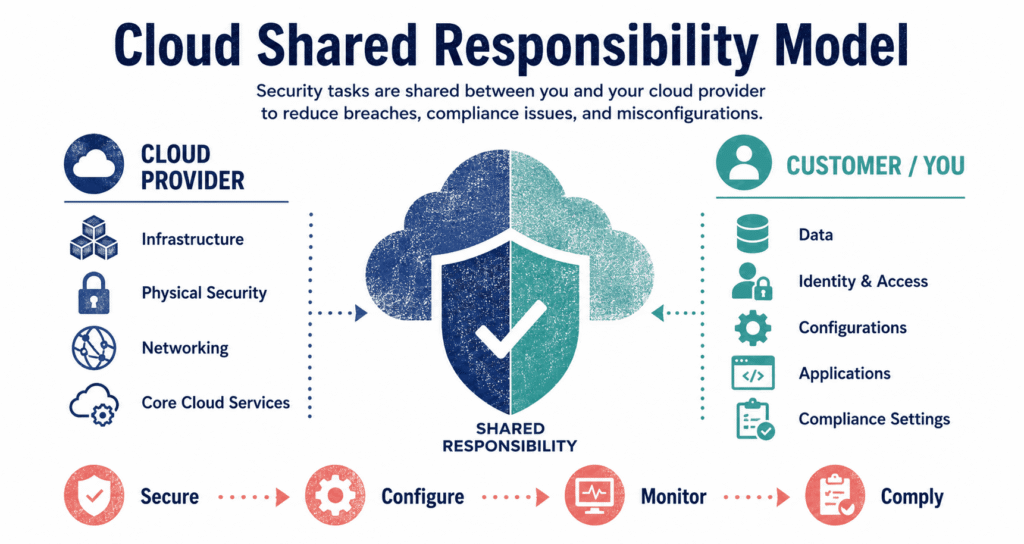
A cloud provider secures the underlying infrastructure. You secure everything you put on top of it. Failing to understand exactly where that boundary sits is the root cause of almost every major cloud data breach over the past decade.
Amazon Web Services popularized a simple mantra to explain this operational split:
“AWS is responsible for security OF the cloud. The customer is responsible for security IN the cloud.”
— AWS Shared Responsibility Model
Think about renting an apartment. The landlord provides a solid door, a working lock, and perimeter building security. That represents security of the building. But if you leave your front door wide open and your television gets stolen, the landlord is not liable. You failed to secure your own space.
You control the data, access rules, and application logic.
They control the physical facilities and core services.
How the Responsibility Line Shifts
The model is not static. The line separating your duties from the provider’s duties moves depending on the type of cloud service you consume.
When organizations adopt serverless architectures, they shift massive amounts of operational overhead to the provider. You no longer care about Linux kernel vulnerabilities. But here is the catch: your application code and identity policies become your absolute final defense layer. A vulnerability in your serverless function’s code remains entirely your problem.
The Compliance Illusion
Many engineering teams assume that moving to a certified cloud provider automatically makes their application compliant with industry regulations. It does not.
According to official documentation, providers undergo rigorous audits for SOC 2, HIPAA, PCI-DSS, and GDPR. They prove their physical servers and hypervisors meet these standards. This creates compliance inheritance. You inherit the physical and infrastructural compliance of the vendor.
The hard truth: If a hospital builds an application on a cloud platform, the provider guarantees the physical hard drives are destroyed securely when decommissioned. However, the hospital must still guarantee that patient records are encrypted in transit and that nurses use multi-factor authentication. The provider gives you compliant tools. You must configure them compliantly.
Identity: The New Security Perimeter
In a traditional on-premises data center, the firewall was the perimeter. In the cloud, identity is the perimeter.
Cloud APIs are exposed to the internet by design. A developer with over-privileged credentials can delete production databases from a coffee shop halfway across the world. Network rules offer little protection if an attacker steals a valid, high-privilege API key. This introduces the strict need for the principle of least privilege. An application reading from a storage bucket should not hold permissions to delete that bucket. Managing these granular access policies is entirely the customer’s responsibility.
Where Most Engineering Teams Fail
Cloud breaches rarely involve zero-day exploits against the provider’s hypervisor. They almost always stem from customer misconfigurations. The sheer scale of cloud platforms makes it easy to make a catastrophic mistake.
Decision Matrix: Who Owns What?
When building your cloud strategy, use this matrix to understand exactly who carries the operational burden for each component.
| Infrastructure Layer | IaaS Owner | PaaS Owner | SaaS Owner |
|---|---|---|---|
| Data & Identity Policies | Customer | Customer | Customer |
| Application Code | Customer | Customer | Provider |
| Operating System Patching | Customer | Provider | Provider |
| Network Controls & Firewalls | Customer | Shared | Provider |
| Physical Hardware & Facilities | Provider | Provider | Provider |
Key Takeaways
- The shared responsibility model dictates that providers secure the infrastructure, while customers secure the data and applications they deploy on top of it.
- The exact division of labor changes based on the service model. IaaS requires heavy customer management, while SaaS shifts most operational burdens back to the provider.
- Compliance is inherited only at the physical and infrastructural level. You remain legally responsible for configuring your architecture to meet regulatory data standards.
- Identity and Access Management (IAM) replaces the traditional network firewall as the primary security boundary in modern cloud environments.
- Provider-side breaches are exceptionally rare. The vast majority of cloud data leaks result from customer misconfigurations, such as public storage buckets and leaked API keys.
Conclusion
The cloud does not magically solve security. It simply changes the nature of the problems you have to solve.
By offloading physical security, hardware lifecycle management, and network virtualization to providers with massive dedicated security budgets, your engineering team can focus their limited resources entirely on securing the application logic and data layers. But that requires treating configuration as code, implementing strict identity boundaries, and auditing your environments continuously. You own the data. You own the risk.
Before provisioning your next resource, double-check the access policies. The provider has locked the building, but you still have to lock your front door.