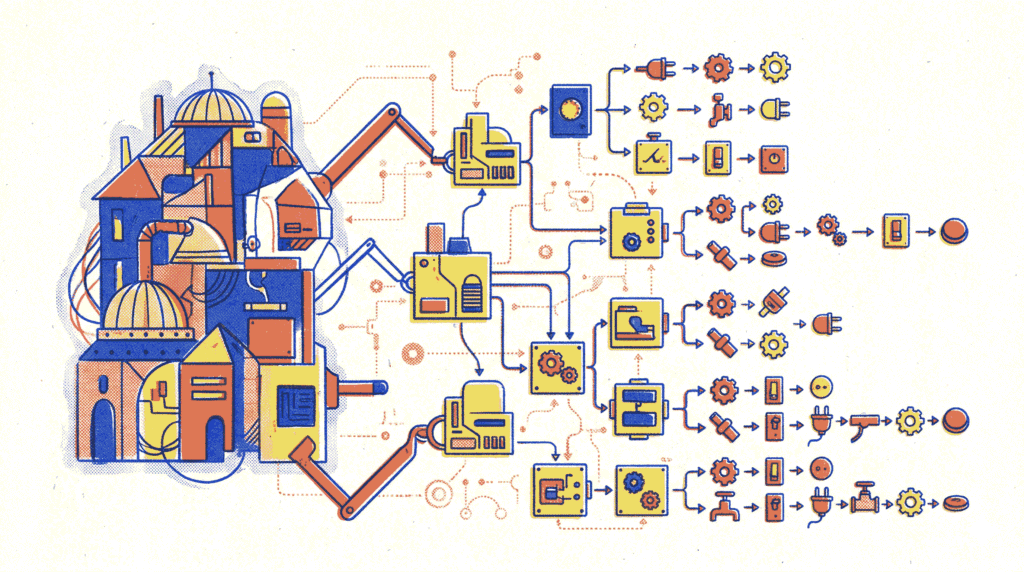
The Anatomy of an Intelligent Task
Imagine asking a robot to “clean the house.” To a human, this vague instruction triggers a cascade of mental subtasks: vacuum the floors, dust the shelves, take out the trash, and perhaps mop the kitchen. For an AI agent, however, a high‑level goal like this is meaningless without further elaboration. This is where autonomous goal decomposition comes into play. It is the cognitive engine that allows intelligent agents to translate abstract, complex objectives into a structured sequence of executable actions. By systematically breaking down a daunting problem into a hierarchy of smaller, manageable sub‑goals, agents can navigate uncertainty, allocate resources efficiently, and ultimately achieve outcomes that would be impossible to tackle monolithically. In this article, we will dissect the mechanics of autonomous goal decomposition, explore various algorithms, and examine its critical role in modern AI systems.
What Exactly Is Autonomous Goal Decomposition?
At its core, autonomous goal decomposition is the process by which an agent transforms a given high‑level objective into a plan—a partial order of lower‑level tasks that are directly actionable. Rather than relying on a human to provide a detailed step‑by‑step script, the agent reasons about the task’s structure. It identifies preconditions (what must be true before an action), postconditions (what becomes true after), and dependencies between steps. Consequently, the agent can dynamically adjust its plan if the environment changes or if an action fails.
This capability separates simple “reflex” agents from truly intelligent ones. A thermostat reacts to temperature; it does not decompose a goal. In contrast, an agent tasked with “planning a weekend trip to Paris” must decompose this into booking flights, reserving a hotel, checking visa requirements, and creating an itinerary. Each of these sub‑goals further decomposes (e.g., booking a flight requires searching, comparing prices, and entering passenger details). For a broader perspective on how agents collaborate, see our guide on multi-agent systems.
The Hierarchical Nature of Task Decomposition
Effective autonomous goal decomposition is rarely a flat list. Instead, it forms a goal tree or hierarchical task network (HTN). The root represents the primary objective. Branches represent sub‑goals, and leaves represent primitive actions that the agent can execute directly (e.g., “move to location X” or “query database Y”). This hierarchical structure provides several critical advantages.
- Abstraction Management: High‑level planning algorithms only need to reason about coarse sub‑goals, ignoring the gritty details of how to “grasp a cup” until necessary.
- Reusability: Once an agent learns how to decompose “book a flight,” that knowledge can be stored as a macro‑operator and reused whenever travel is involved.
- Robustness: If a leaf action fails (e.g., “payment declined”), the agent can backtrack up the tree and try an alternative sub‑goal (e.g., “use a different credit card”) without invalidating the entire plan.
- Parallelism: The tree structure reveals which sub‑goals are independent and can be pursued concurrently, drastically reducing overall execution time.
This hierarchical approach is a stark contrast to flat sequences generated by standard Chain‑of‑Thought prompting. While CoT excels at linear logical deduction, autonomous goal decomposition adds the dimension of structured, revisable planning.
Core Algorithms for Goal Decomposition
Over the years, several families of algorithms have been developed to enable autonomous goal decomposition. Each has distinct strengths and is suited to different environments.
1. Hierarchical Task Network (HTN) Planning
HTN planning is the classic AI approach. The agent possesses a library of methods. Each method describes one way to decompose a non‑primitive task into a set of subtasks. For example, a method for “travel from A to B” might decompose into “take taxi to airport,” “fly A to B,” and “take train to city center.” The planner recursively expands tasks until only primitive actions remain. HTNs are particularly effective in domains with well‑defined standard operating procedures, such as manufacturing or logistics.
2. LLM‑Based Decomposition (ReAct & Plan‑and‑Solve)
With the rise of Large Language Models, a new paradigm has emerged. Instead of hard‑coded methods, agents can use LLMs to dynamically generate a decomposition. The ReAct framework interleaves reasoning traces and actions. Similarly, the Plan‑and‑Solve strategy explicitly prompts the LLM to first generate a step‑by‑step plan before execution. This approach is incredibly flexible and requires no pre‑defined operator library. However, it is prone to “hallucinations”—inventing plausible but non‑existent actions (e.g., “calling a plumber” when the agent has no phone interface).
3. Means‑Ends Analysis (MEA)
Popularized by the General Problem Solver (GPS), MEA works backward from the goal state. It identifies the most significant difference between the current state and the goal state. Then, it searches for an operator that reduces that difference. This process repeats recursively. While MEA can be computationally expensive, it is a powerful framework for autonomous goal decomposition when the state space is large and ill‑defined.
4. Recursive Decomposition with Verification
A modern technique combines LLM generation with verification loops. An agent proposes a decomposition, then a separate “critic” agent (or a symbolic verifier) checks if the plan is logically sound and respects resource constraints. If not, the plan is refined. This aligns with the principles of the Tree‑of‑Thought framework, where multiple decomposition paths are explored and pruned based on evaluation.
The Challenge of Goal Conflict and Non‑Linear Dependencies
A significant hurdle in autonomous goal decomposition is managing interactions between sub‑goals. Actions taken to achieve Sub‑Goal A might inadvertently sabotage Sub‑Goal B. For instance, an agent tasked with “cleaning the kitchen” and “preparing dinner” might realize that using harsh chemicals to clean the oven makes the kitchen unsafe for food preparation. Resolving such conflicts requires the agent to reason about causal links and resource constraints.
Advanced planners address this through threat resolution. If Step X threatens a precondition of Step Y, the planner can impose an ordering constraint (e.g., “Step Y must happen before Step X”) or find an alternative decomposition that avoids the conflict altogether. This level of strategic foresight is what distinguishes robust autonomous systems from brittle scripts. Moreover, handling these nuances is essential to avoid the statistical pitfalls described in Simpson’s paradox, where aggregated success rates hide critical failure modes.
Real‑World Applications of Autonomous Goal Decomposition
Autonomous goal decomposition is not merely an academic exercise. It powers numerous cutting‑edge applications across industries.
- Robotics and Warehouse Automation: Amazon’s Kiva robots and Boston Dynamics’ Spot rely on HTN‑like planners to navigate shelves, avoid obstacles, and fulfill orders. A high‑level goal (“retrieve item A7 from shelf B3”) decomposes into path planning, grasping, and verification steps.
- Virtual Assistants and Smart Home Routines: When you say, “Hey Google, I’m leaving,” the agent decomposes this into turning off lights, adjusting the thermostat, locking doors, and arming the security system.
- Autonomous Vehicles: A goal like “navigate to the airport” decomposes into a continuous cycle of lane‑keeping, traffic monitoring, route selection, and merging maneuvers. The decomposition is dynamic, constantly adjusting to new obstacles.
- Software Development Agents: Tools like GitHub Copilot Workspace or Devin decompose high‑level feature requests (“add a login page”) into a concrete plan: create a database schema, write API endpoints, design the HTML form, and write tests.
- Healthcare Treatment Planning: AI systems in radiology can decompose the goal of “analyze a chest X‑ray” into sub‑goals: identify the lung fields, detect nodules, measure cardiothoracic ratio, and generate a structured report.
The Role of Learning in Goal Decomposition
While traditional HTNs rely on hand‑coded methods, the future lies in learned decomposition. Agents can be trained via demonstration or reinforcement learning to discover optimal ways to break down tasks. For instance, an agent might watch thousands of videos of humans assembling furniture and learn a hierarchical policy. This approach is more scalable and adaptable than manual engineering. Furthermore, techniques like curriculum learning naturally emerge: the agent first masters simple subtasks (e.g., “pick up a screwdriver”) before tackling complex composite goals (“build a chair”).
In the context of federated learning, edge devices could collaboratively learn shared decomposition strategies while keeping individual user data private. This would allow a smart home system to learn that “prepare for bed” means slightly different things in different households (e.g., closing blackout blinds vs. just dimming lights).
Evaluating the Quality of a Decomposition
Not all decompositions are equal. A poor plan is inefficient or destined to fail. Here are key metrics used to evaluate autonomous goal decomposition:
- Completeness: Does the plan actually achieve the stated goal when executed correctly?
- Soundness: Does the plan avoid invalid states or actions that violate constraints?
- Optimality: Is the plan the “cheapest” or “fastest” way to achieve the goal (often measured in time, resource consumption, or probability of success)?
- Robustness: How sensitive is the plan to small perturbations or execution failures? A robust plan includes fallback options.
In LLM‑based systems, these metrics are often assessed using a combination of automated validators and human preference ratings (RLHF).
Limitations and the Path to General Intelligence
Despite remarkable progress, autonomous goal decomposition still faces significant challenges. The “common sense” problem is persistent: an LLM might suggest “call a tow truck” as a sub‑goal, but fail to realize the agent has no phone or money. Additionally, long‑horizon tasks (spanning days or weeks) are notoriously difficult. The plan can become stale as the world changes. Moreover, the computational cost of exploring deep goal trees can be prohibitive for real‑time applications. For deployment on edge hardware, the resulting plans often need to be paired with efficient models, which is where techniques like model quantization and distillation become essential.
Looking ahead, the integration of symbolic planning (for logical rigor) with neural methods (for flexibility and learning) holds the most promise. This neuro‑symbolic approach aims to combine the interpretability and verifiability of HTNs with the adaptability of LLMs.
Conclusion: Building the Cognitive Pyramid
In summary, autonomous goal decomposition is the fundamental process that elevates AI agents from simple command‑executors to genuine problem‑solvers. By hierarchically breaking down complex tasks, agents can navigate the messy realities of our world, recover from errors, and optimize their behavior. Whether through classical HTN planning or modern LLM‑based strategies, the ability to structure a path from a vague intention to a concrete set of actions is indispensable. As we strive toward more general and capable AI, mastering the art of decomposition—both in our code and in our own thinking—will remain a cornerstone of creating systems that truly work for us.
Further Reading: Continue your journey into AI planning and reasoning with our articles on Tree‑of‑Thought Framework, Chain‑of‑Thought Prompting, and Multi‑Agent Systems. For a deep dive into HTN planning, visit the Wikipedia article on Hierarchical Task Networks.