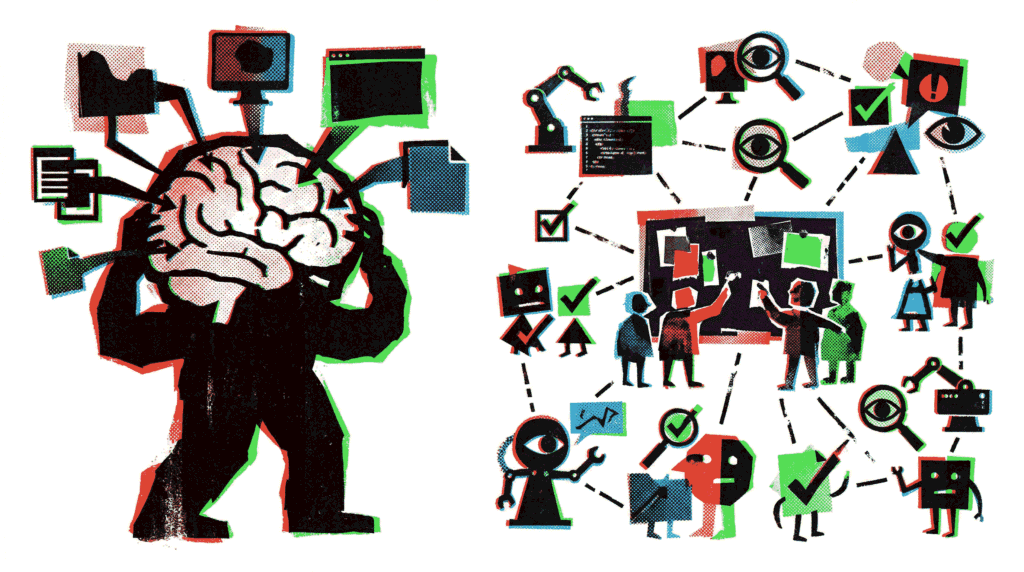
From Solo Performers to Collaborative Teams
In the early days of artificial intelligence, systems were designed as monolithic entities. A single model was tasked with everything—from understanding a query to generating a response. However, as problems grow more complex, this approach reveals its limitations. Enter multi-agent systems (MAS). This paradigm shifts the focus from one large brain to a society of specialized agents working together. Each agent possesses its own goals, knowledge, and capabilities. Consequently, they communicate, negotiate, and coordinate to solve problems that would overwhelm any individual agent. In this article, we will dive deep into the mechanics of multi-agent systems, exploring how they orchestrate collaborative AI workflows across diverse industries.
What Defines a Multi-Agent System?
A multi-agent system is a computerized system composed of multiple interacting intelligent agents within an environment. Unlike a distributed computing task where workers simply execute parallel subtasks, agents in MAS are autonomous. They have control over their actions and internal state. Furthermore, they possess a degree of social ability—they can communicate with other agents via a defined language or protocol. Finally, they exhibit reactivity (responding to changes) and pro‑activeness (taking initiative to achieve goals).
To visualize this, consider a smart home. Rather than a central hub making every micro‑decision, a multi-agent system would involve a thermostat agent negotiating with a window agent and an occupancy agent to optimize comfort and energy use. Each agent knows its own domain best. This decentralized approach is not only more robust but also easier to scale and maintain. If you are interested in how individual agents can reason through complex logic, check out our guide on Chain‑of‑Thought prompting.
Key Characteristics of Intelligent Agents
To understand how multi-agent systems function, we must first look at the building blocks. An agent in this context typically possesses the following traits:
- Autonomy: Agents operate without direct human intervention and have control over their internal state and behavior.
- Local Views: No single agent has a complete global view of the system. This decentralization is crucial for scalability.
- Specialization: Agents are often designed with specific skills. One might excel at web search, another at writing Python code, and a third at fact‑checking.
- Interaction: They do not live in isolation. Agents constantly share information, request services, or negotiate resources.
How Agents Communicate and Coordinate
Communication is the glue that holds a multi-agent system together. Without a shared understanding, the system devolves into chaos. There are several common coordination mechanisms.
1. Direct Message Passing
Agents send structured messages to specific recipients. This is analogous to a directed conversation. Languages like FIPA‑ACL (Foundation for Intelligent Physical Agents – Agent Communication Language) or simple JSON payloads define the semantics of the exchange. For example, an agent might send a “Request” message to a database agent or an “Inform” message to a logger agent.
2. Blackboard Systems
In this model, agents share a common workspace—the “blackboard.” An agent writes a partial solution or a new piece of data onto the board. Subsequently, other agents monitor the board for changes and react when they see an opportunity to contribute their expertise. This is particularly useful for complex, multi‑step reasoning tasks like scientific discovery or complex engineering design. It resembles how a team of specialists might collaborate around a whiteboard.
3. Auctions and Contract Nets
When tasks need to be assigned to the most capable agent, economic mechanisms come into play. A manager agent announces a task. Then, worker agents submit bids based on their current workload and capability. The manager awards the task to the best bid. This Contract Net Protocol ensures efficient resource allocation in dynamic environments, such as logistics or cloud computing scheduling.
Architectures for Multi-Agent Systems
The topology of a multi-agent system dictates its resilience and performance. The two primary architectural styles are:
- Hierarchical (Vertical) Architecture: Agents are organized in a tree‑like structure. Higher‑level agents decompose tasks and delegate sub‑goals to lower‑level agents. This is easy to manage but introduces a single point of failure at the top.
- Heterarchical (Horizontal) Architecture: Agents are peers. There is no central controller. Coordination emerges from local interactions. This is highly robust and scalable but can lead to inefficiencies or conflicts if not carefully designed.
Modern implementations often blend these approaches. A central “orchestrator” agent might manage the high‑level workflow while allowing specialized agents to negotiate peer‑to‑peer for specific sub‑tasks. This hybrid model provides a balance of control and flexibility.
Benefits of Orchestrating Collaborative AI Workflows
Why are leading AI labs and enterprises investing heavily in multi-agent systems? The advantages over monolithic models are compelling.
- Enhanced Problem‑Solving Capabilities: Complex problems can be decomposed into specialized domains. A coding agent writes the function, a reviewer agent checks for bugs, and a documentation agent writes the README. This division of labor yields higher quality outputs.
- Improved Reliability and Robustness: If one agent fails or provides a poor answer, the system can query another agent or re‑route the task. There is no single point of catastrophic failure.
- Scalability and Modularity: Need to add a new capability? Simply plug in a new agent without retraining or re‑architecting the entire system. This aligns well with the philosophy of serverless architectures.
- Mitigation of Hallucinations and Bias: Agents can act as checks and balances. A “skeptic agent” can fact‑check the output of a “creative agent,” significantly reducing the propagation of incorrect information.
- Reusability: Agents are self‑contained components. A web‑scraping agent built for one project can be reused instantly in another workflow.
Challenges in Building Multi-Agent Systems
Building a cohesive team of AI agents is significantly more complex than deploying a single model. Developers must navigate several unique challenges.
- Coordination Overhead and Deadlocks: Agents must agree on protocols and sequencing. Poor design can lead to deadlocks where Agent A waits for Agent B, while Agent B waits for Agent A.
- Non‑Stationarity: From the perspective of a single learning agent, the environment is constantly changing because other agents are also learning and adapting. This violates the common assumptions of standard reinforcement learning.
- Communication Costs: In a large system, the sheer volume of inter‑agent messages can consume significant bandwidth and compute resources. Therefore, efficient communication protocols are essential.
- Emergent Behavior and Unpredictability: Simple local rules can sometimes lead to complex, unexpected global behaviors. While sometimes beneficial (emerging intelligence), it can also lead to undesirable oscillations or system crashes.
- Security and Trust: In an open multi-agent system, a malicious agent could join the network and spread false information or disrupt the consensus mechanism. Establishing trust and reputation models is critical.
Popular Frameworks and Tools for Multi-Agent Development
Fortunately, the barrier to entry for building multi-agent systems has lowered dramatically thanks to robust open‑source frameworks. Here are some of the leading platforms:
- Microsoft AutoGen: A framework developed by Microsoft Research for simplifying the orchestration of LLM workflows. It allows agents to converse with each other and even with humans to solve tasks. Learn more about AutoGen.
- CrewAI: A cutting‑edge framework designed for role‑playing autonomous AI agents. CrewAI emphasizes “crews” of agents with specific roles, goals, and tools, making it intuitive for complex collaborative tasks. Explore CrewAI.
- LangGraph: Built on top of LangChain, LangGraph provides a way to model agent interactions as graphs. This allows for cyclic computations and stateful multi‑actor applications, which are essential for persistent conversations. Check out LangGraph.
- OpenAI Swarm: An educational framework exploring lightweight multi‑agent orchestration. It focuses on routines and handoffs, demonstrating core MAS principles in a minimal codebase. View on GitHub.
- JADE (Java Agent DEvelopment Framework): A mature, FIPA‑compliant framework for building distributed multi‑agent applications in Java. It is widely used in academic and industrial research.
Real‑World Applications of Collaborative AI Workflows
Multi-agent systems are not just a theoretical construct; they are actively transforming industries. Here are several compelling applications.
- Supply Chain Optimization: A manufacturer, a shipper, and a retailer agent can negotiate prices, inventory levels, and delivery schedules in real time, optimizing the entire logistics chain dynamically.
- Autonomous Scientific Discovery: One agent generates hypotheses, another designs experiments, a third analyzes simulation data, and a fourth writes the draft paper. This closed‑loop system can accelerate research in chemistry and materials science.
- Financial Trading and Risk Management: Multiple trading agents monitor different market signals, assess risk, and execute hedging strategies, reacting to market shifts far faster than human teams.
- Smart Grid Management: Distributed energy resources (solar panels, EV chargers, batteries) are managed by agents representing consumers, utilities, and the grid operator to balance load and prevent outages.
- Game AI and Simulations: Non‑player characters (NPCs) in modern video games often function as a multi-agent system. They coordinate attacks, share information about the player’s location, and react realistically to the dynamic world.
- Customer Support Automation: A routing agent directs queries to specialized agents: a returns agent, a tech support agent, and a billing agent. They collaborate to resolve complex issues without escalating to a human unless necessary.
The Relationship Between Multi-Agent Systems and Advanced Reasoning
The power of multi-agent systems is amplified when combined with other advanced AI techniques. For instance, if a complex task stumps an agent, the system can employ a Tree‑of‑Thought framework to explore multiple solution paths before committing. Similarly, agents can use Chain‑of‑Thought prompting internally to reason through their specific sub‑tasks. In scenarios where agents must process diverse data types—perhaps one agent analyzes images and another reads text—the principles of multimodal learning become crucial. Moreover, for privacy‑sensitive applications where agents operate on local user data, techniques from federated learning ensure that collaborative intelligence doesn’t come at the cost of individual privacy.
The Future of Collaborative AI Workflows
Looking ahead, the line between human teams and multi-agent systems will continue to blur. We are entering an era of human‑agent collectives, where AI agents become persistent teammates rather than transient tools. These agents will have long‑term memory, distinct personalities, and a deep understanding of their human collaborators’ preferences. Furthermore, as edge computing matures, we will see swarms of lightweight agents deployed on local devices, enabling real‑time, privacy‑preserving collaboration in smart homes and autonomous vehicles.
The development of standardized agent communication languages and open protocols will be key to avoiding a fragmented ecosystem. Just as HTTP enabled the World Wide Web, a universal agent protocol could unlock an “Internet of Agents,” where specialized AIs from different vendors can discover each other and collaborate seamlessly.
Conclusion
In summary, multi-agent systems represent a fundamental shift in how we design intelligent software. By orchestrating collaborative AI workflows, we can tackle problems of unprecedented complexity, moving beyond the limitations of any single model. While challenges like coordination overhead and emergent behavior exist, the benefits of robustness, specialization, and scalability are undeniable. Whether you are building the next generation of autonomous research assistants, optimizing global logistics, or creating immersive game worlds, understanding and leveraging multi-agent systems will be essential. The future of AI is not a single brain; it is a collaborative society.
Further Reading: Deepen your understanding of AI workflows with our articles on Chain‑of‑Thought Prompting, Tree‑of‑Thought Framework, and Multimodal Learning. For technical implementations, explore the documentation for Microsoft AutoGen and CrewAI.